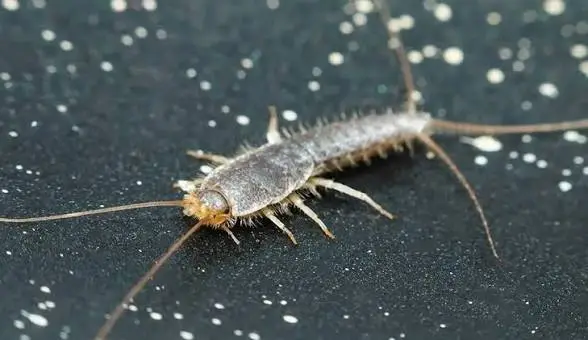
The first silverfish most people meet is half-dead, stranded at the bottom of a dry bathtub at six in the morning, wriggling against a wall it can't climb. The reaction is almost always the same. The house suddenly feels dirty. Out come the sprays, the hardware-store bait, the sticky traps, and a weekend of scrubbing skirting boards.
A month later, there's another one in the tub.
Here is what that second silverfish is telling you: the problem was never dirt, and it was never really the bug. Silverfish are one of the very few household pests whose entire presence is dictated by a single number, the relative humidity of the air in the room they're living in. Get that number wrong, and no amount of cleaning, trapping, or spraying will move them. Get it right, and they leave on their own, because the building stops being survivable.
That reframe changes everything about how you deal with them. So let's walk through what silverfish are actually responding to, why the standard advice mostly treats symptoms, and what genuinely ends the problem.
The Bug in Your Bathtub Is Telling You Something
Start with where you see them, because the location is data.
Silverfish are nocturnal and spend daylight wedged in cracks, darting for cover the second you move whatever they're hiding under. So the ones you find in the bath, the sink, or the basin aren't living there. They wandered in overnight, chasing moisture, slid down the smooth porcelain that their feet couldn't grip, and couldn't climb back out. The bathtub is a trap they built for themselves. It is not a nest.
That distinction matters because most people treat the sighting spot as the target. They spray the bathroom and wonder why nothing changes. The silverfish you can see is the tourist. The breeding group is somewhere darker and damper: a wall cavity, the back of a vanity, behind built-in shelving, up in a roof space. The sighting tells you the general humidity zone. It does not tell you the source. Reading the building, not the bug, is the whole game.
Traps Don't Kill the Problem. They Find It.
This is where the standard advice quietly falls apart. Sticky traps and DIY jar traps get sold as a solution, as if catching silverfish thins the population enough to matter. It doesn't. A handful stuck to a glue board is a rounding error against a breeding group you never see.
Traps are genuinely useful, though, for a completely different job: triangulation.
Set cheap sticky traps in a loose grid, a few per room, tucked into corners, under sinks, along the backs of cupboards, beside the hot water system. Leave them a week. The traps that fill up are pointing straight at the moisture. Heavy catches under the laundry tub and nothing in the lounge mean the laundry has a damp problem you haven't found yet. You've just converted a pest into a free moisture survey. Stop asking "how do I catch them all," which you can't, and start asking "where is it wet," which the traps will answer for the price of a coffee.
You Can't Starve a Silverfish, But You Can Dry It Out
The next myth is that silverfish are a food problem, that sealing the cereal and clearing the pantry will starve them out.
It won't, because silverfish eat the building itself. Extension entomologists list their diet as wallpaper paste, book bindings, paper, photographs, the starch in clothing, cotton, linen, rayon, and even dead insects, according to Ohio State University. Your home is a buffet, whether or not the pantry is locked down. Worse for the starvation plan, they can survive several months with no food at all. Trying to starve them is close to hopeless.
Water is a different story. Silverfish lack the waxy outer cuticle that lets most insects lock moisture in, so they have to live in air that does the holding for them. They need relative humidity in the 75 to 95 per cent range to thrive. Pull the air below roughly 50 percent and their world flips from buffet to desert. You cannot take away their food. You can absolutely take away their water. That asymmetry is the entire strategy in one sentence.
The Repellents That Quit Exactly When You Need Them
Then there's the natural-remedy shelf: cedar blocks, citrus peel, cucumber slices, diatomaceous earth. Some carry a kernel of truth. Most carry a catch.
Diatomaceous earth is the honest example. It's a fine powder that kills insects by abrading and drying out their shells, and it does work on silverfish. The catch is baked into the mechanism. It only works while it stays bone dry. Spread it in a steamy bathroom or a damp subfloor, the exact places silverfish actually live, and it clumps, soaks up moisture, and goes inert. You're deploying a drying agent into the one environment wet enough to switch it off.
Cedar and citrus are milder again: a scent that nudges them along briefly and then fades. None of these touches the reason the silverfish showed up. They're an air freshener for a plumbing problem.
Here's the comparison worth keeping in your head:
| Approach | What it actually does | How long it lasts |
| Sticky / jar traps | Maps where the moisture is | Diagnostic only, never a cure |
| Sprays, cedar, citrus, DE | Kills or repels the few you reach | Short, and fails in the damp where they live |
| Humidity control | Removes the condition they need to survive | Permanent, as long as the air stays dry |
Two of those three are things you do to the silverfish. Only the third changes whether silverfish are possible at all.
Drop the Humidity and the Argument Ends
So the real task isn't pest control in the spray-can sense. It's moisture control.
Run the bathroom and kitchen exhaust fans, and make sure they actually vent outside rather than dumping into the roof. Fix the slow leaks under sinks and behind toilets. Ventilate the subfloor and any wardrobe sitting against a damp external wall. In a genuinely humid room or climate, add a dehumidifier and hold the air under 50 per cent. Below that line, eggs struggle to hatch, young silverfish can't molt, and adults simply dry out. The population doesn't get poisoned. It gets evicted.
Two field notes on how this plays out in real homes….
First, new builds and fresh renovations. People move into a new house or finish a big reno, suddenly "have silverfish," and they're baffled because everything is spotless. The cause is the building. Curing plaster, fresh screed, and green timber push moisture into the air for months, and silverfish pour into new buildings while the walls are still damp. That's not a hygiene failure. It's a building that hasn't dried out yet, and it usually settles once it does.
Second, the callback that isn't about the bug at all. A spotless home, treated three times, sprayed and sealed and bombed, and the silverfish came back every single visit. The hygrometer in the ensuite sat in the low 80s. The real fault was an exhaust fan venting straight into the roof cavity instead of outside, quietly keeping the whole upper floor humid. No spray on earth fixes a fan ducted to the wrong place. Reroute the duct, the humidity drops, and the silverfish have nowhere left to be.
That second scenario is also the moment to stop doing it yourself. If you've dried out everything you can reach and they keep returning, the moisture source is hidden somewhere you can't get to: a weeping pipe inside a wall, a subfloor that never breathes, a roof leak tracking down a beam. That's when it's worth bringing in someone who hunts the source instead of spraying the symptom, the way a moisture-literate crew like SWAT Pest Control Brisbane has to work in a climate where the air fights you most of the year. In subtropical humidity, you're not killing silverfish. You're out-engineering the weather indoors.
The Real Question Isn't What to Spray
So the next time one turns up stranded in the bath, resist the reflex to reach for poison. Reach for a hygrometer instead.